
Learning Math Without Fear and Limits
Eye Level Math ensures that young minds master every Math concept in incremental steps at their own pace through individualized coaching. We tailor study plans to match each student’s abilities and learning pace. Our learning environment nurtures self-directed learning habits in children, like planting seeds of curiosity and independence.

Eye Level Math (4 – 15 y/o)
Eye Level Math is a comprehensive program that covers basic and advanced math concepts, emphasizing critical thinking and practical skills. It helps students master arithmetic operations, develop mathematical thinking, and improve concentration, study habits, and self-confidence. The program builds a strong foundation for future academic and professional pursuits.
Eye Level Math ensures that young minds master every Math concept in incremental steps at their own pace through individualized coaching. We tailor study plans to match each student’s abilities and learning pace. Our learning environment nurtures self-directed learning habits in children, like planting seeds of curiosity and independence.
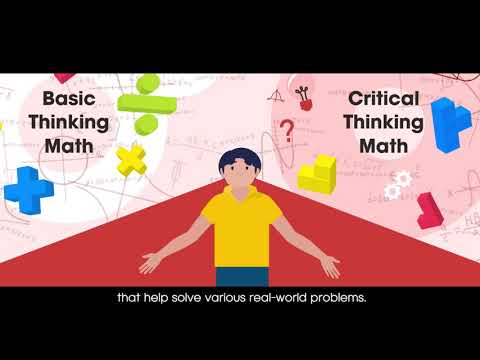
We help students to build a solid foundation in fundamental areas of math and mathematical problem-solving skills through Basic Thinking Math (BTM) and Critical Thinking Math (CTM). Suitable for all ages and abilities, our comprehensive math syllabus not only aligns with our national and international curriculum but also enhances it to perfectly complement your child’s school learning.

Basic Thinking Math
Basic Thinking Math enables students to complete the foundation of mathematics and covers the following study areas: Numbers, Arithmetic, Measurement (Application of Arithmetics), Equations, Relationships and Functions, Probability and Statistics, Variables and Equations.


Critical Thinking Math
Critical Thinking Math enables students to develop depth perception, problem solving, reasoning skills, and covers the following study areas: Patterns and Relationships, Geometry, Measurement, Problem solving and Reasoning.


🤝 Our Promise 🤝
Learning without fear

We offer a safe learning environment, empowering children to be self-directed learners unafraid of seeking help or making mistakes.
No calculators here! Instead, our students build confidence by trusting their mental processing skills with numbers, fostering a reliance on their own abilities.
Learning without limits

We use a building-block structure to enhance your child’s understanding of the basics before progressing to more complex concepts.
Coupled with personalized one-to-one coaching from our expert instructors, this approach guides your child on their unique learning journey, reigniting their passion for learning.
We support your child

When we say we adapt our program to suit your child, we mean more than just course content. Each child’s Eye Level experience is entirely bespoke.
Our supportive instructors take the time to understand your child as an individual, discovering their preferred learning style.
Get started TODAY!
Experience the Eye Level difference for yourself with a FREE consultation, learning assessment, and sample study plan — no obligation to enroll!
Your inquiries about Eye Level Math, answered
The Eye Level Math program is meticulously designed to encompass the entire curriculum, catering to students from preschool through 16 years old. Comprising 32 levels and boasting over 14,000 pages of material, the program is structured for a 3-4 year completion period if followed consistently. Its small, incremental steps facilitate a logical and linear mastery of mathematical concepts.
Deliberately divided into two components, students progress through each at their own pace. Basic Thinking Math (BTM) addresses number, arithmetic, and measurement, focusing on pure mathematics. Critical Thinking Math (CTM) encompasses patterns, relationships, geometry, problem-solving, reasoning, and probability, dealing with applied mathematics. All students utilize physical workbooks and teaching tools as they navigate and complete the program.
Eye Level Math takes a very explanatory approach to learning mathematics. Questions and concepts are illustrated and explained in many ways and with many examples to provide a good and solid understanding to the student before moving on to the actual mathematics practice. The student will apply this understanding when answering the questions. This helps develop students’ power of thinking.
BUILD A STRONG FOUNDATION IN BASIC MATH SKILLS
It is important to ensure that your child has a good grasp of arithmetic operations, such as addition, subtraction, multiplication, and division. Building a strong foundation in these skills will help your child develop a better understanding of more advanced concepts and problem-solving skills.
DEVELOP MATHEMATICAL THINKING SKILLS
Developing mathematical thinking is essential for success in math. This involves learning how to analyze problems, identify patterns, and apply logical reasoning to solve mathematical problems. Encourage your child to practice critical thinking and problem-solving skills by providing them with challenging math problems.
MAINTAIN GOOD STUDY HABITS
To achieve success in mathematics, cultivating good learning habits is essential. One key method of building these habits is by experiencing small achievements during daily studies.

Since every child is unique and has a different learning pace, repetition is required to ensure that he/she achieves the necessary understanding, speed and accuracy.
According to the Ebbinghaus’ Forgetting Curve, the more we re-learn a topic, the more data we will retain.
However, repetition of booklets is assigned only when necessary, according to your child’s performance, and Instructor’s observation and understanding of his/her abilities and skills.
While we do assign homework to reinforce new skills and knowledge between classes, we strive to make this experience entirely manageable. We understand that parents want to be involved in supporting their child’s learning journey without necessarily taking on the role of the primary educator—after all, that’s why they’ve chosen us. Anticipate your child spending more time with us and less time negotiating academic tasks at home, ensuring a smoother learning experience for both students and parents.
At Eye Level, our students have the flexibility to attend once or twice a week, a decision left entirely to the parent or student’s preference. The structure ensures that choosing between the two options does not fundamentally impact progress or attainment. While there’s no time fixation in our approach, as we don’t prescribe set class durations or time completion metrics, we prioritize careful observation and one-on-one coaching for effective mastery determination.
A child remains in class until they’ve perfected the day’s work, with completion time varying based on factors such as the child’s age, level, ability, and duration of their Eye Level engagement. On average, once settled, a child might spend around 45 minutes per subject.
There will be a short Comprehensive Assessment test in the middle and last booklets of each BTM and CTM levels. This Comprehensive Assessment summarizes all the concepts that have been taught in the previous booklets of that level. The student understanding and mastery will be briefly assessed through this test.
Furthermore, the Eye Level Instructors will record the results of every completed booklet each week. More importantly, the Instructors will determine the exact nature of the mistakes and also how to improve the student’s understanding and mastery through proper instruction and booklet repetition as needed. Besides that, instructors’ observation in the class will be one of the assessing tools.
All of a child’s activities, whether at home or in class, are meticulously documented in our student dashboard within the Key and Manager application. Monthly, we assess progress against each student’s study projection, a metric diligently tracked by our Eye Level Instructors. Upon completion of each level, students undergo a Level Test. This test serves as a tool to predict and manage the transition to above-curriculum-level work.
Upon enrolment, we provide an estimated timeframe for this achievement and consistently keep you informed about your child’s progress in relation to this milestone. Feel free to request this information at any point during your journey with us.
The time needed to complete one level will also depend in part upon, the student’s age and Eye Level Math Level. If the student is studying an Eye Level Math level which is below his/her school grade, i.e. below what he/she has already been taught in school, the need for repetition may be less. However, if the student is studying above the school grade, i.e. learning new concepts and skills, the need for booklet repetition will increase to reinforce the new concepts and give more practice. This is to ensure a good and thorough understanding of the Eye Level Math skills. At higher Eye Level Math levels, the questions do become more difficult and time consuming and it may take the student slightly longer to complete a higher level than a lower one.
As a rough guideline and assuming no repetition, students attending classes twice a week can complete one level in about 1-2 months. For students attending class once a week, one Eye Level Math BTM Level can be completed in about 2 months and one Eye Level Math CTM Level in about 2-3 months.
Both Eye Level Math and Kumon Math are supplementary Math development programs for children. However, there are a few notable differences between the two programs.
The two programs take a slightly different approach to learning. Kumon’s approach is focused on developing calculation skills, and it is often described as a drilling and practice-makes-perfect approach. Eye Level’s approach is based on the idea of creating a comprehensive understanding of mathematics and English. Eye Level aims to develop and perfect the child’s power of thinking and understanding through its emphasis on critical thinking. In particular, Eye Level teaches Critical Thinking Math, which is generally not a component of other Mathematics programs, including Kumon.
Kumon uses clearly defined criteria for speed and accuracy when determining a student’s satisfactory progress and level of mastery. Students who do not meet these criteria often will be asked to repeat the booklets again. Eye Level Math also has a set of criteria to follow to determine mastery and booklet repetition, and Eye Level students also will be re-assigned booklets for reinforcement of concepts not mastered. However, the structure and design of the Eye Level booklets aids a child’s tolerance of such review. Eye Level Math workbooks for both the pre-school and primary school levels are colorful and contain a variety of exercises focused on related concepts and applications of those concepts (e.g. word problems), whereas Kumon only provides colorful worksheets for the beginning levels and contains relatively few word problems in the higher levels. This seemingly simple dissimilarity can mean the difference between a child being engaged in review and the same student being bored with a review.
Kumon Math covers a basic Math curriculum up to a higher level than Eye Level. In Kumon, students can study up to a pre-university and even university level of Mathematics. Eye Level Math’s Basic Thinking Math curriculum only covers up to about 11th grade. Eye Level aims to perfect your child’s Mathematical thinking, providing a good understanding and foundation of Mathematical knowledge. Your child can then apply these acquired skills to their higher levels of study through the also developed self-discipline and good study habits. In that sense, Eye Level Math very much focuses on application, an aspect of the program which is most easily seen in the consistent inclusion of word problems throughout the Eye Level Math program.
The Eye Level learning center is NOT the conventional tuition center. Eye Level does not group students according to age or school grade, but rather according to their individual eye-level mathematical ability. Eye Level Math is a tailored, individual learning program. Eye Level Math believes that each child is special and unique. The child’s starting level of study and progress through the program will be based on his/her individual eye-level ability and capability.
In Eye Level Math, students can also progress to study above their school grade. Furthermore, because Eye Level Math is an international mathematics program, there may be a few chapters in the Malaysian school curriculum that are not covered by Eye Level Math, while Eye Level Math may teach/cover some topics in more detail when compared to the Malaysian syllabus.
Eye Level Math aims to give children a good understanding and foundation of mathematical skills. The child can then apply these understanding and problem-solving skills to other aspects of their education. Eye Level Math also teaches Critical Thinking Math, which cannot really be compared to any subject taught in schools or any other mathematics program.
